Air conditioning
Condenser, evaporator coil, blower motor, refrigerant charge and controls on split systems, heat pumps and mini-splits.
AC serviceSERVICE OPERATION · TRACK 01
Residential and light commercial air conditioning, heating, ductwork and preventive maintenance. Every visit starts the same way: read the complaint, read the equipment, read the measurements.

INDEX · 04 LINES
Four disciplines, one diagnostic method. Problems often overlap — a “no cooling” call can end up as a refrigerant charge issue, a airflow restriction, or both.
Condenser, evaporator coil, blower motor, refrigerant charge and controls on split systems, heat pumps and mini-splits.
AC serviceFurnaces, heat pumps and air handlers: ignitor, inducer blower, heat exchanger, gas valve, limit switches and low-voltage control wiring.
Heating serviceFlex duct runs, trunk lines, registers, return air and static pressure problems. Duct sizing and balancing where airflow is the root cause.
DuctworkFilter changes, coil cleaning, drain line flush, current and voltage checks, and seasonal changeover on systems you already own.
MaintenanceDISPATCH LOG
What callers actually describe, and what the visit usually turns into. Stop numbers follow the order a technician works the complaint.
Thermostat is calling for cool, unit runs, but the air is warm. Usually a failed run capacitor, a tripped breaker, a closed or locked-out contactor, or low refrigerant from a leak.
Check first: breaker, filter, thermostat mode, then nameplate data.
Every vent blows, barely. A dirty evaporator coil, a clogged filter, a failing blower motor or a collapsed flex duct run can all produce the same complaint.
Check first: filter condition, coil face, blower amp draw, static pressure at the return.
Blank screen, no calls to the equipment, or schedule that won’t hold. Often the thermostat itself, the 24 V transformer, low-voltage wiring, or a R-C wire left open at the changeover.
Check first: voltage at the sub-base, battery or C-wire, terminal labels.
No flame, no heat. A failed hot-surface ignitor, an open flame sensor, a tripped high-limit switch, an inducer that never proves out, or a gas valve that won’t open.
Check first: limit switch continuity, inducer proof of operation, flame sensor rod.
The fan never comes on and the compressor stays silent. Contactor pitting, a bad capacitor, a low-voltage control signal, a seized motor or a tripped breaker all present the same way from inside.
Check first: contactor pitting, capacitor microfar reading, control voltage at the outdoor unit.
Condensate overflow. A plugged drain line, a dirty coil, a mis-set float switch or a pan that’s out of level all end up dripping into the room or into the return plenum.
Check first: pan level, drain slope, float switch continuity, algae in the line.
Ice on the evaporator or line set. Low airflow and low refrigerant both starve the coil; so does a dirty filter or an undersized duct system running long call periods.
Check first: filter, coil freeze pattern, superheat and subcooling, charge by weight.
Repeated trips on the HVAC circuit point at a short, a failed capacitor, a seized motor winding or an overcurrent unit drawing more than it should. Treat a repeat trip as a diagnostic request, not a reset.
Check first: which circuit, what was running at the trip, motor amp draw.
Runs for a few minutes, shuts down, repeats. Undersized charge, a cycling-capable thermostat set too tight of a differential, an oversized unit on the load, or low airflow hitting the low-pressure switch.
Check first: low-pressure switch behaviour, superheat, thermostat differential, load match.
Rattling, squealing, buzzing or grinding. A loose panel, a failing bearing in the blower motor, a worn condenser fan blade, a vibrating compressor, or refrigerant in the wrong line set.
Check first: where the noise starts, panel fasteners, motor bearings, blade damage.
Scheduled changeover work: coil cleaning, drain line flush, filter, belt or motor inspection, electrical connections, refrigerant pressures and a written reading of system performance.
Also a good moment to note SEER2, AFUE or HSPF data for future decisions.
Which filter, how often, where does it go. The right answer depends on the return: a high-MERV filter or a media filter in a tight return needs a properly sized system and a clear filter rack.
Check first: filter size against the return opening, not the cabinet door.
Swap or upgrade with wiring done to the equipment it controls — common or C-wire, R-C handling, humidity or smart features that need a compatible equipment board.
Check first: equipment type, wiring length, whether the existing stat matches the system.
STOP 04 · AIR CONDITIONING
A cooling complaint is a measurement problem before it is a parts problem. Service on a split system or heat pump generally follows this sequence:
If a leak is found, the repair location matters — a line set or coil replacement changes the approach to setting the charge, and a repair without finding the leak means the call comes back.

STOP 05 · HEATING
Gas furnace, electric furnace, boiler-side hydronics and heat pumps all fail in recognizable patterns. A no-heat call usually resolves to the flame proving sequence, an airflow or limit problem, or a control fault.
Furnace efficiency is quoted as AFUE; heat pumps are quoted as HSPF. Comparing two systems with different fuel types or different vent sizes is misleading without those numbers.
STOP 06 · DISTRIBUTION
When the equipment is fine and the house still isn’t comfortable, the distribution system is the suspect. Duct problems are common in attics, crawlspaces and retrofits where the original design was a guess.
The number that explains most weak-airflow calls. Measured at the return plenum with the system running, it shows how hard the blower is working. Too high means restriction somewhere; too low often means a leak or an oversized system.
Duct sizing sets the CFM, and the CFM sets what the coil can do. An oversized unit on a small duct system will freeze coils and short cycle regardless of how clean everything is.
Crushed runs, kinked inner liner, disconnected joints and insulation peeled back in a vented attic. A single collapsed run can take out half the bedrooms on one floor.
Registers that are undersized or blocked behind furniture, and returns that are choked off. Both quietly reduce the airflow the system needs to move heat.
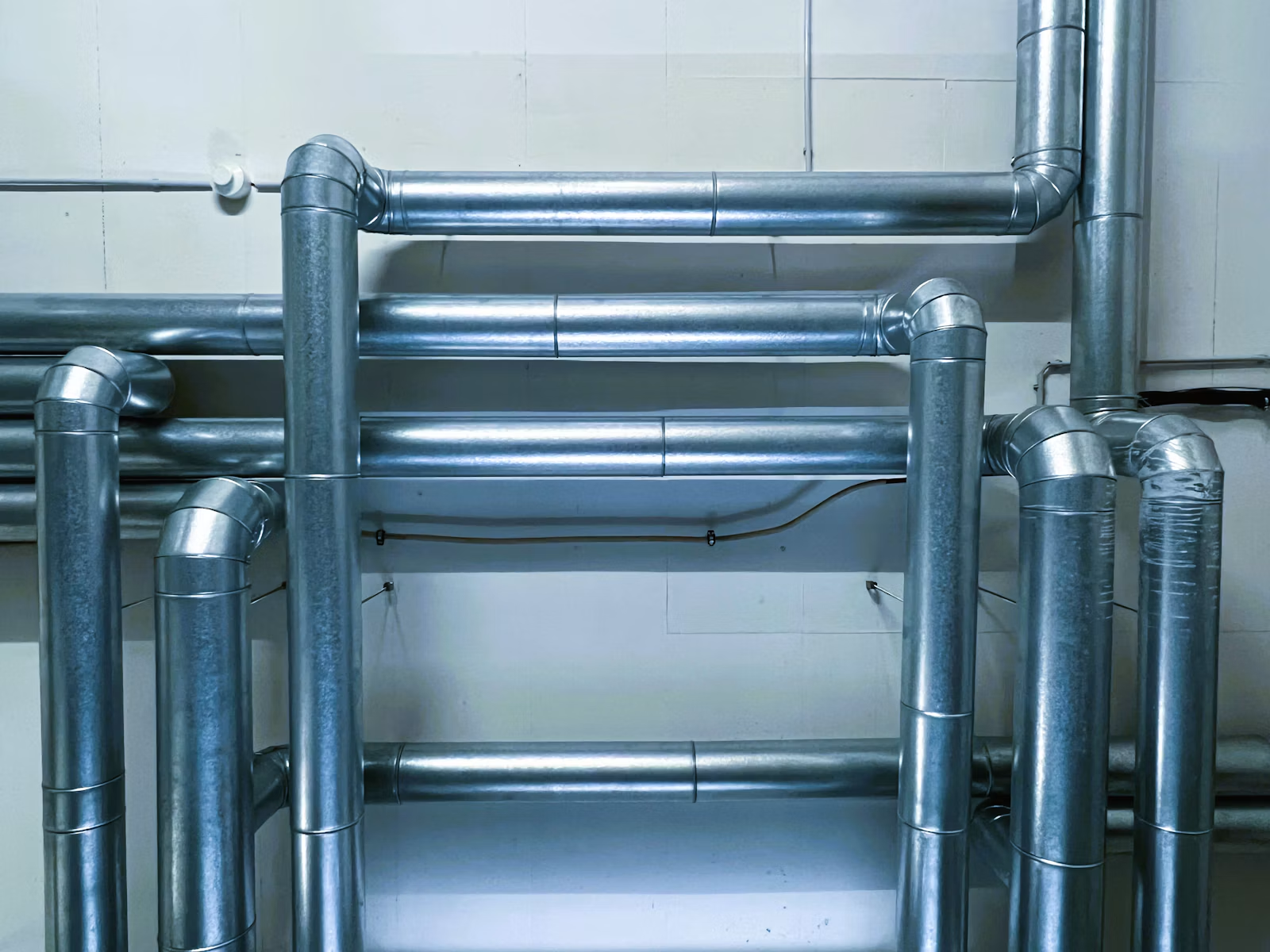
Galvanized trunk, transition tapers, and takeoff fittings that were added after the fact. Metal ducts can also corrode at the return, pulling air in where it should be contained.
Testing, adjusting and balancing. Balancing means measuring each room’s airflow and adjusting dampers so the system delivers what the design intended, rather than overfeeding one side of the house.
STOP 07 · PREVENTIVE
Preventive maintenance is the least glamorous part of the trade and the reason equipment lasts. Most no-cooling and no-heat calls are a deferred filter change and a coil that was never cleaned.
Keep a small log per system: filter dates, what was found, what was measured. When a unit is eight years old, that log is the only thing that narrows a fault down.
STOP 09 · INTAKE
Describe the symptom the way you’d say it out loud. The more specific the complaint, the faster the diagnosis lands on the right part of the problem.